OUR MISSION
TO ELIMINATE THE USE OF PLASTIC IN THE COMMUNITY AS MUCH AS POSSIBLE
——-+——>
retailer support, research, education, and local ordinance.
WHAT YOU CAN DO
Reduce Plastic Usage
Start with small changes that you and your family/friends can make at home.
Reduce plastic usage around your food
– bring non-plastic reusable bags to the stores
– use glass, ceramic or stainless steel containers to hold your food
– switch to non-plastic kitchen utensils
– switch to non-plastic cutting boards
Check the labels of your clothes
– gradually replace your clothes made of synthetic fabric, such as nylon, polyester, and rayon with natural fabric such as cotton, silk, wool, and linen.
Join Events
Oct 14, 1:30 pm. Niles Senior Center.
Health Impact of Plastic and What to Do about It.
Jan 13, 2027, 1 pm. Prospect Heights Public Library, Health Impact of Plastic and What to Do about It.
About Silicone
It is best if silicone doesn’t touch your food. Make sure the silicone that touches food is not heated. Many containers have a silicone lid. That is ok, given that choices are limited. Avoid those that have a silicone spout where steam exits the container when heated. Avoid cooking muffins in silicone molds or baking pans. Avoid silicone spatulas or other utensils that touch your hot food. High quality, pure silicone does not react to acidic food, but those with a filler may leach into the food. Lastly, silicone is not recyclable.
About Bamboo
Bamboo is often touted as sustainable. Bamboo clothing is called bamboo viscose or rayon. To make it into clothing, it needs to go through several toxic chemicals. In recent years, some manufacturers use a Lyocell process to process bamboo cellulose with less chemicals and recycle 99.5% of the chemicals used. As for bamboo furniture, they are glued together with large amounts of adhesives which often contain harmful chemicals. Furthermore, imported products require fumigation in transit to kill insect larvae, which often leave behind a chemical residual.
Guidelines for Plastic Alternatives
There is a lot of greenwashing (deceptive advertising that claims to be green) out there. In moving away from plastic, choose items that can be reused an unlimited number of times.
Guidelines:
1. Check the material to see if it’s natural or synthetic. In clothing, synthetic materials have plastic in them. Non-synthetic or natural materials include cotton, silk, linen, and hemp. For non-clothing items, natural materials include wood, stainless steel and glass. Ceramic is also acceptable.
a. Check the label or material description and fine prints to make sure the product has as little or no plastic or chemicals in them.
b. Do not fall for words like, eco-friendly, sustainable, or recyclable. Those are unsubstantiated claims. Check the description.
c. Organic material is even better. They are grown without pesticides.
d. Socks and underwear often have 3% spandex for the elastic. That’s ok because those items need the elastic to stay on.
e. Do not fall for a cotton blend material, not even an organic cotton blend. If it’s 70% cotton and 30% polyester, then 30% of it contains plastic.
f. Items that claim to be free of a certain chemical. such as bpa, phthalates, or pfas may have other substituted chemicals that are just as bad. E.g. items that are BPA-free may have BPS or BPF that are just as bad or worse.
g. Most paper cups and containers have a plastic lining inside to make them waterproof. Most aluminum cans have a plastic lining inside to prevent corrosion.
h. Most paper, bamboo, and plant-based straws and even some glass straws contain pfas. Drinking without a straw would eliminate single-use waste. Stainless steel straws are found to be plastic-free.
2. For an alternative material that is not natural, such as silicone and bamboo, check to see if they are good alternatives for what you use them for.
a. Check if it has any chemicals that can harm human health.
b. Do not get the analysis from the manufacturer’s website. Check scientific research.
c. Consider how you would use the product. Would you put it in the oven or microwave? Some products leach chemicals when heated.
d. Does it have fragrances that can be harmful to health?
e. Check if the production of the product is energy intensive.
f. Check if the alternative is recyclable, or can be reused for a long time.
Support State Legislation
ne plastic-related bill was passed in the last IL session and was signed into law by Governor Pritzker:
HB4418 EPA Stormwater Plastic Pellets – EPA to require facilities getting a National Pollutant Discharge Elimination System (NPDES) permit to control plastic pellets or other preproduction plastic materials in stormwater runoff from their facilities. This bill has passed the General Assembly on May 28, 2026.
— * —
We are working on 2 bills this legoslative session.
SB1531 Farewell to Foam – Coalition for Plastic Reduction has been working on the bill for the last 5 years. See Chicago Tribune article.
SB1872 Plastic Bag Reduction Act – prohibits retail stores from offering single-use checkout bags to customers. The bill will allow the retailers to collect 10 cents for a paper bag. It is being drafted by IEC and the specifics may change.
— * —
PARK RIDGE PLASTIC BAG BAN
Come January, the Park Ridge single-use plastic bag ban will be in effect for retail stores over 7,500 sf. This is the perfect time for residents to bring reusable shopping bags to stores.
The ban is a good thing for 3 reasons: health, waste, and climate change. For more information about why it’s good for your health, why it reduces waste, and why it helps with climate change, click here.
What are the alternatives to single-use plastic bags? The best options are no bag or organic cotton bags. Organic cotton bags are meant to be reused for a very long time. For details, click here.
— * —
OAK PARK PLASTIC BAG TAX
Oak Park currently charges 10 cents for single-use paper and plastic bag at checkout of large retail stores over 5,000 sf. stores. The 10 cent fee did not reduce overall bag usage. Oak Park will increase that fee to 15 cents in 2027, 20 cents in 2028, 25 cents in 2029, and in 2030, single-use plastic bags will be banned in all retail stores.
WHAT WE ARE DOING
Retailer Support
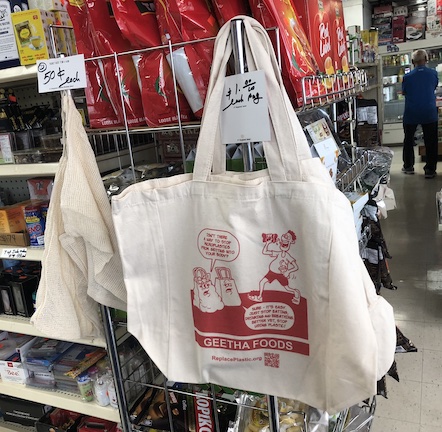
We helped Geetha Foods eliminate plastic shopping bags at their store.

Winnetka Farmers’ Market sold 200 – 100% cotton bags on Saturdays through Oct. 25, 2025.

Paper Bag Collection for reuse in the stores.
We previously had a large donation of new paper bags from Evanston District 65.
Research

Patch article by Ivy Sundell, What Does Your Health Have to Do with Plastic?
Other articles:
ScienceDaily, Could Plastic in Your Foods be Fueling Alzheimer’s?
New Yorker, How Plastics Are Poisoning Us
Ecology Center, About BPA and BPS in Receipt Paper
CNN Health, Common Household Plastics Linked to Global Deaths from Heart Disease
NPR, Should You Toss Your Plastic Kitchen Tools for Health Reasons? Here’s the Scoop
California Attorney General, Plastic Bag Manufacturers Settle Claim that Plastic Bags are Recyclable in the State.
See more articles on the Research page.
Education

We have made presentations on What to Use Instead of Plastic at the Skokie Library, North Shore Senior Center, and Niles Senior Center.
We plan to present to the Planet Panther Club at Joseph Sears School for the Earth Day events next year.
April 30, 2026. Ivy spoke to the Citizens Utility Board members about the health impact of plastic at Sketchbook Brewing Co.
A 17-min excerpt of Dr. Robert Sargis’ presentation on Plastics & Human Health at Sketchbook.


Follow us on Instagram and Facebook
for Tips Tuesday… Find plastic alternatives in your daily life.
…and Health Friday. Understand how plastic is linked to all major medical illnesses.
Local Ordinance
Park Ridge
We are working with the Sustainability Commission on public education about plastic.
Skokie
We are working with Go Green Skokie and 2 trustees to discuss ways to introduce e plastic bag ban.
Kenilworth
We are exploring ways to have the few retail stores switch to non-plastic bags.
The Plant, Chicago
With the help of The Plant manager, we are working with a few of the tenants at The Plant to replace their plastic wraps, trays and containers with alternatives.
OUR SPONSORS




WE ARE A MEMBER OF: